
What Happens If You Accept a Cash Offer and the Buyer Backs Out?
If you are a Charlotte homeowner thinking about accepting a cash offer, this is one of the most important questions to ask up front.
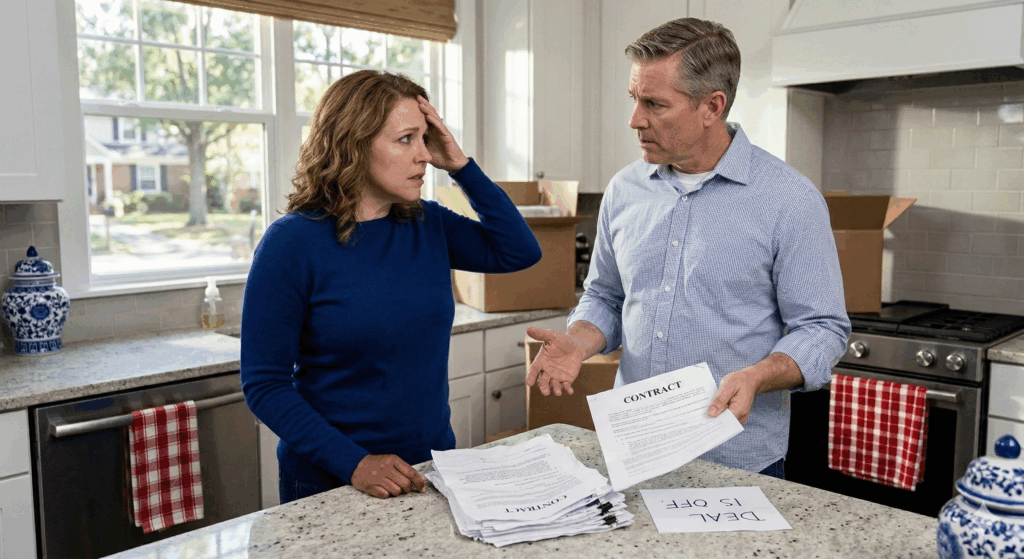
Because the honest answer is this: yes, a buyer can back out. And when that happens, the seller is usually the one left dealing with the stress, the lost time, and the frustration of having to start over.
A lot of companies love to talk about how easy a cash sale is. What they do not always explain is what happens if the deal falls apart before closing. That part matters, especially if you have already started making plans, packing boxes, or counting on the proceeds from the sale to move on to the next chapter.
Not all cash offers are the same
Some cash buyers are legitimate. They have the funds, they know what they are buying, and they are prepared to close.
Others get a house under contract first and try to figure out the rest later. Sometimes that means they go looking for a partner, an end buyer, or a way to rework the numbers after the fact. And if that does not come together, the seller is the one left wondering what just happened.
We recently talked to a seller in Pineville who was about 20 days into a contract before the “cash buyer” disappeared because they could not find a partner for the deal. By then, the seller had lost valuable time and had to start all over. That is exactly why this question matters so much.
Just because someone says “cash offer” does not mean the deal is solid. What matters is whether they can actually close, what the contract allows them to do, and how much risk you are really taking on once you sign.
According to the Consumer Financial Protection Bureau, earnest money is intended to show good faith, and if a buyer does not perform in good faith, that money may be forfeited to the seller.
The National Association of REALTORS® also explains that earnest money may be refunded to the buyer if a contract is terminated under certain contingency provisions. In other words, the fine print matters more than most people realize.
In North Carolina, the contract timing matters
Here in North Carolina, the due diligence period is a big deal. A seller can feel like the house is as good as sold, but depending on the contract, the buyer may still have a fairly easy exit ramp.
The North Carolina Real Estate Commission explains that during the due diligence period, a buyer can terminate the contract for any reason or no reason at all by giving written notice. In that case, the buyer typically gets the earnest money back, but not the due diligence fee, unless the contract says otherwise.
That is why a home being “under contract” is not always the same thing as having a secure sale. There can still be real risk sitting there in the paperwork, even while the sign in the yard makes it look like everything is moving forward.
What does that actually cost a seller?
It can cost money, yes. But more often, it costs momentum.
You lose time on the market. You may miss other interested buyers. And if the contract drags on for a couple of weeks before falling apart, you are not stepping back into the market in the same place you started. Buyers start asking questions. Sellers feel discouraged. The whole thing gets heavier than it needed to be.
That is why I would say it this way: a high price on a contract does not pay your moving truck. A closed deal does.
How to protect yourself before you sign
1. Ask for proof of funds
Do not be shy about this. A real cash buyer should be able to show proof of funds quickly.
Rocket Mortgage explains that proof of funds is documentation showing a buyer has liquid funds available to complete the purchase. That can help a seller verify the buyer is actually in a position to close.
2. Look closely at the earnest money deposit
Earnest money tells you something about the buyer’s level of commitment.
NAR describes earnest money as a good faith deposit and notes that if a buyer backs out for reasons not allowed under the contract, the seller may be entitled to keep it.
If the earnest money is very small, that can be a sign the buyer has very little at risk if they decide to walk away.
3. Understand the due diligence period
In North Carolina, this is one of the biggest things to pay attention to.
A long due diligence period can leave you in limbo, especially if you have already stopped showings and emotionally moved on. The North Carolina Real Estate Commission makes it clear that the length of the due diligence period is negotiable, and during that time the buyer can terminate for any reason or no reason.
That does not mean every buyer will do that. It just means you need to know what protections you do and do not have before you sign.
4. Ask who is actually closing
This is a big one. Is the person making the offer actually buying your home, or are they trying to assign the contract to someone else?
Most homeowners do not know to ask that question, but they should. If your buyer is really just hoping to hand the deal off to someone else, that adds another layer of uncertainty you need to understand from the beginning.
When a cash offer still makes sense
A cash offer can absolutely be the right move.
For some Charlotte homeowners, speed and simplicity matter more than squeezing every last dollar out of the property. Maybe the home needs repairs. Maybe there is a tenant in place. Maybe it is inherited property, or maybe life just got complicated and you want a cleaner path forward.
There is nothing wrong with choosing convenience. You just want to make sure you are choosing real convenience, not just a promise that sounds good on the front end.
Final thought for Charlotte homeowners
If you are comparing a cash offer, don’t just ask how much they are offering.
Ask how likely they are to close. Ask what happens if they do not. Ask whether they have proof of funds, how much earnest money they are putting down, and whether they are the actual buyer.
At JMS Home Buyers, we believe sellers deserve straight answers. Sometimes a cash offer is the best fit. Sometimes listing on the market will put more money in your pocket. The right choice depends on your house, your timing, and what matters most to you.
But whatever you do, make sure you are comparing more than price. Because a contract only helps if it gets to the closing table.