
You may, but a short sale is not a right. A short sale happens only when your lender agrees to accept less than you owe, and eligibility depends first on who owns or insures your loan. Fannie Mae, FHA and private lenders each set their own rules, which can include a hardship, a delinquency requirement, financial documentation or a contribution toward the shortfall.
Before you look at any of those rules, find out whether you actually have a shortfall. Compare your written payoff statement with an agent’s estimate of what your home would net if listed as-is. An investor’s cash offer gives you one more option to compare. A low investor offer alone does not mean you need a short sale.
What a short sale situation can look like
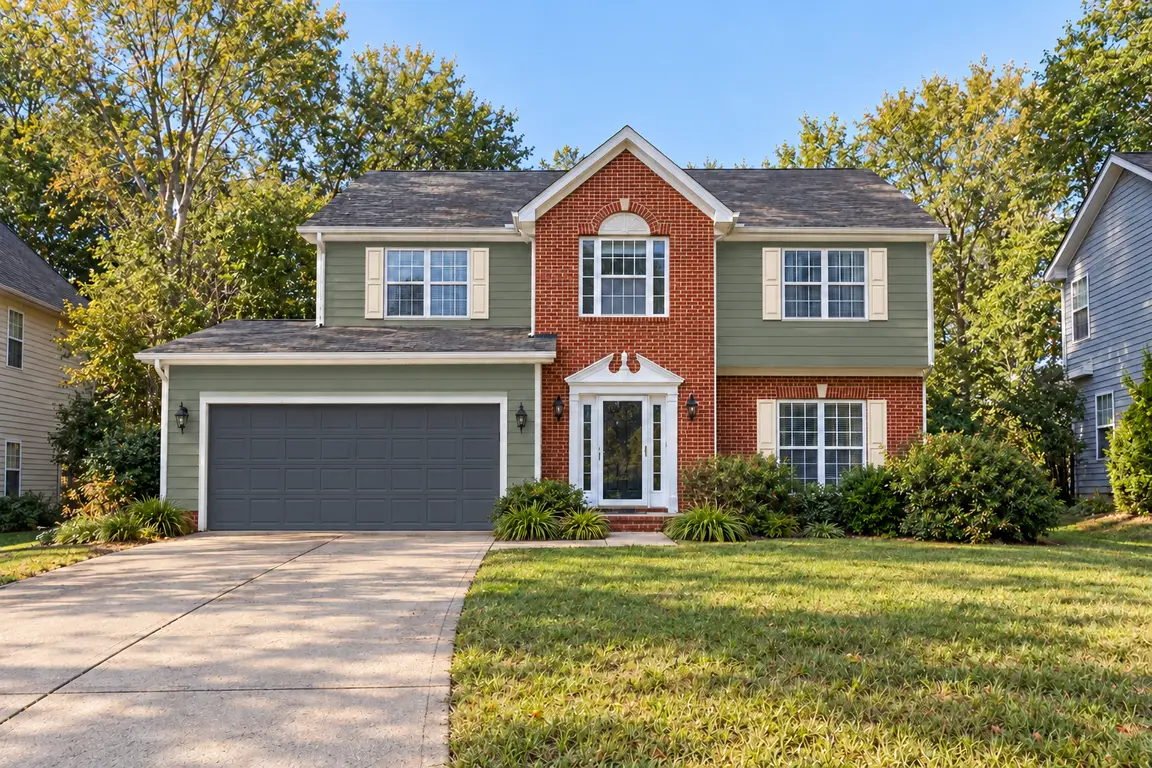
Consider this example. A homeowner has a house built in the early 2000s. It has been well cared for, but the roof, the HVAC system and the kitchen are all original, and the next buyer will see every one of them. Then a job transfer comes through, to a city several hundred miles away, with a start date that will not wait.
The homeowner needs to sell. The problem is the math. Updated homes on the street sell for about $650,000, but this one needs roughly $60,000 of work before it would compete with them. The payoff on the mortgage is about $590,000.
| Option | Sale price | Estimated costs | Estimated net | Compared with the $590,000 payoff |
|---|---|---|---|---|
| Investor cash offer, as-is | $460,000 | Varies by offer | About $460,000 before any seller-paid costs | About $130,000 short |
| As-is listing | $585,000 | About $40,000 in commissions and closing costs | About $545,000 | About $45,000 short |
| Repair first, then list | $650,000 | About $60,000 in repairs plus $39,000 in agent compensation at 6%, before other closing costs | About $551,000 before other closing costs | About $39,000 short |
(Numbers are illustrative and rounded. Agent compensation is negotiable and is shown at 6% only for illustration.)
This homeowner has not necessarily done anything wrong. Even listed on the open market, the house cannot sell in its current condition for enough to pay off the loan. Repairing first does not solve it either: even if the homeowner found $60,000 for repairs, the sale would still fall short of the payoff under these assumptions. That is the gap a short sale exists to solve, if the lender agrees.
Why can repairs create a shortfall in a strong market?
Repairs create a shortfall because buyers pay for the house in front of them, not the house it could be. A home’s value after repairs and its value as-is can be tens of thousands of dollars apart, especially when big-ticket systems like a roof or HVAC are near the end of their life. Neighborhood sales of updated homes can make it look like there is plenty of equity, when the as-is number tells a different story.
For a closer look at how condition drives price, see What Will a Cash Buyer Pay for My House? and Why Is My Cash Offer So Low?
What hardships do lenders accept for a short sale?
The rules depend on who owns or insures your loan, so the first question to ask your servicer is who owns it. Here are two examples of how different the rules can be.
Fannie Mae loans. A homeowner who is current, or less than 60 days behind, can be evaluated for a Fannie Mae short sale only if the servicer determines a payment default is expected soon. A hardship alone is not enough. Under that evaluation, the homeowner generally must live in the home as a principal residence, submit a complete application package, have less than $25,000 in non-retirement cash reserves and document a hardship such as:
- Death of a borrower or of a primary or secondary wage earner in the household
- Long-term or permanent disability, or serious illness of a borrower, co-borrower or dependent
- Divorce or legal separation
- A distant job transfer or relocation, more than 50 miles one way
Having some savings does not automatically disqualify you; Fannie Mae’s rules provide for the servicer to request a contribution toward the shortfall. Fannie Mae also offers eligible owner-occupants $7,500 toward relocation expenses after a completed short sale.
FHA loans. FHA’s rules work differently. Under HUD’s current handbook, a standard FHA pre-foreclosure sale generally requires the homeowner to be at least 61 days behind on payments when the servicer approves it and to have been found ineligible for options that would let them keep the home. FHA’s 50-mile relocation rule applies to servicemembers with permanent change of station orders, not to civilian job transfers. HUD has revised these rules several times in 2025 and 2026, so confirm the current version with your servicer.
Freddie Mac, VA, jumbo and portfolio loans. These follow their own investor or lender guidelines. Loans held by the lender itself follow that lender’s own short sale rules.
Do not stop paying to “qualify” without advice. Some programs, including Fannie Mae’s, permit a short sale while you are current, subject to additional requirements. Other programs, including FHA’s, may require you to be behind, but missed payments add late fees, damage your credit and move you closer to foreclosure. Talk with your servicer and a short sale attorney before you miss a payment.
What does the lender review before approving a short sale?
What the lender reviews depends on the program, but most lenders look at whether the sale price is fair and whether you could pay some of the difference yourself. Depending on your loan, expect to provide some or all of the following:
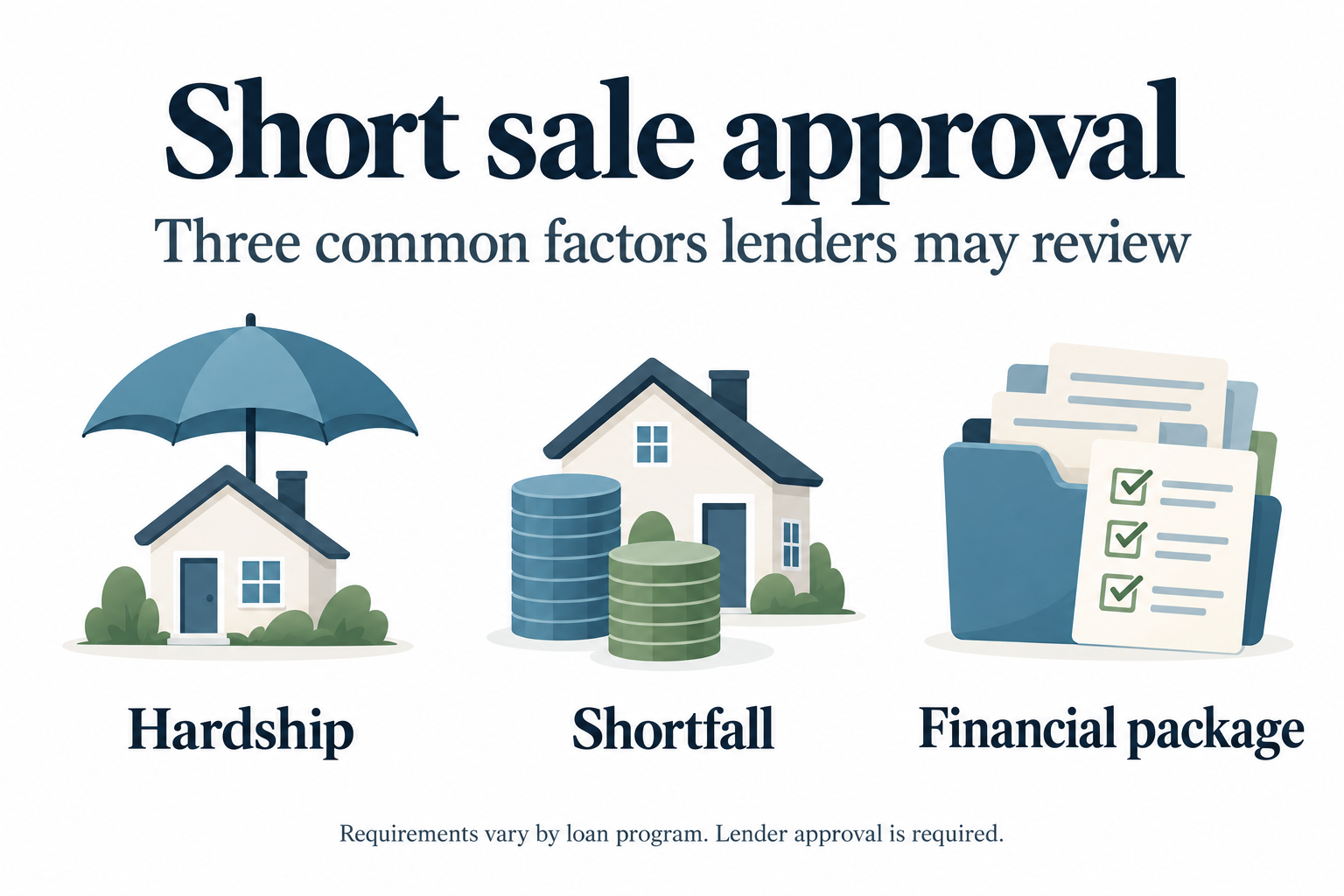
- A written hardship letter explaining what changed
- Recent pay stubs or proof of income
- Bank statements and a list of assets
- Recent tax returns
- A signed purchase contract from a buyer
- A list of every lien on the property, including any second mortgage or home equity line
The lender will also order its own valuation of the home, usually a broker price opinion or an appraisal. If the lender believes the home is worth more than the contract price, it may counter or decline.
Every lien holder has to agree. A home with a first mortgage and a home equity line has two lenders, two reviews and two approvals.
Step one: compare your payoff with an as-is net estimate and an investor offer
Start with your payoff statement. Request it from your servicer in writing. The payoff is usually higher than the balance on your monthly statement, because it includes interest, fees and any past-due amounts.
Next, get an as-is market estimate: a comparative market analysis from a licensed agent, based on recent sales of homes in similar condition, minus estimated selling costs. This is the number that decides whether you need a short sale, because the lender will judge a short sale against its own view of the home’s open-market value.
An investor cash offer provides one more option to compare. It tells you what one investor will pay today, with no repairs, showings or listing. It is not your home’s market value. An investor prices in repairs, holding costs, resale costs and profit, so an investor offer will usually be lower than what an as-is listing could bring, and offers from different investors can vary. Cash describes how a buyer pays, not how they price: a buyer purchasing a home to live in can also pay cash.
As a licensed broker who also owns JMS Home Buyers, I can give you both an as-is estimate and an investor offer. Then put them next to your payoff:
- The investor offer covers your payoff and selling costs. You have equity, and a cash sale may solve the problem quickly, on your timeline.
- The investor offer falls short, but an as-is listing would cover the payoff. You do not need a short sale. Listing the home is likely your better path.
- Both numbers fall short. This is when a short sale conversation makes sense.
What happens when neither number covers the loan?
When the numbers show a real shortfall, my role changes. JMS Home Buyers steps out as the buyer, and I can represent you as your listing agent for a short sale. I am a licensed real estate broker in North Carolina and South Carolina, and I hold the National Association of REALTORS® Short Sales and Foreclosure Resource (SFR®) certification.
Here is how that change works:
- My role is disclosed up front. I own JMS Home Buyers. When JMS makes an offer, I am the buyer, not your agent. I disclose in writing that I am a licensed broker buying for my own company, review the agency disclosure with you and explain what agency means.
- The JMS offer is withdrawn. If the home is headed for a short sale, I withdraw the JMS offer, and my policy is that JMS does not come back in as the buyer on a home I list. Investors can buy approved short sales, and lenders typically require every party to sign an affidavit confirming the sale is at arm’s length. I keep my roles separate so there is never a question about whose interests I represent.
- A short sale attorney works with the lender. I refer sellers to a short sale attorney who handles the lender’s approval process, while I handle the listing, the buyers and the contract.
- The lender approves the fees. Lenders typically review and may limit what brokers and attorneys are paid in a short sale, and those fees are generally paid from the sale proceeds once the lender approves. Confirm with the attorney whether any separate charges apply.
For more on the process itself, see Why a Cash Offer Isn’t Always the Answer: A Short Sale Guide for Ballantyne Homeowners.
What about taxes and leftover debt after a short sale in 2026?
Ask two questions before you accept any short sale approval: will the lender release you from the remaining balance, and will that forgiven amount be taxed?
- Leftover debt. A short sale does not automatically erase what you owe. A lender releasing its lien so the home can sell is not the same as releasing you from the remaining balance, called a deficiency. Whether you could still owe it depends on your loan, your lender and the approval terms. Fannie Mae’s servicing guide directs servicers to release the borrower from the deficiency on its loans, though the servicer may first ask for a contribution. A second mortgage or home equity line lender negotiates its own terms. Ask your short sale attorney to obtain a full written release of liability from every lien holder and to review the approval letters before closing.
- Federal taxes. Forgiven debt is generally treated as income for federal tax purposes. For years, a federal exclusion covered forgiven mortgage debt on a main home, but that exclusion applies only to debt discharged before January 1, 2026, or under a written arrangement entered into before that date. A short sale that closes in 2026 without that earlier arrangement may create taxable income unless another exception, such as insolvency or bankruptcy, applies. Talk to a CPA before you sign.
Why does a short sale matter compared with foreclosure?
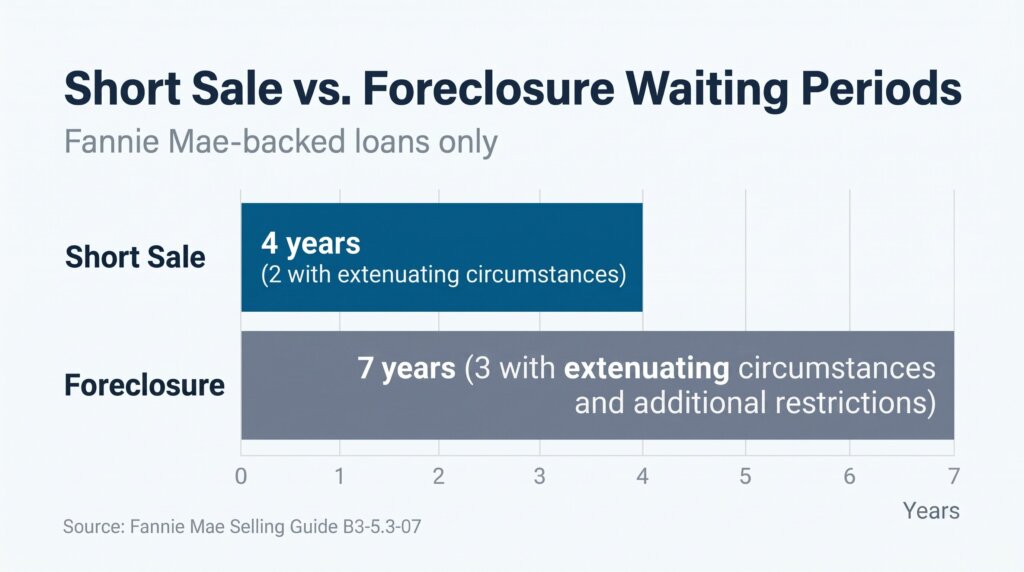
A short sale can shorten the wait before you qualify for a new mortgage. Under Fannie Mae’s rules for loans it backs, the standard wait is four years after a short sale, or two years with documented extenuating circumstances. After a foreclosure, the standard wait is seven years, or three years with documented extenuating circumstances and additional restrictions. Other loan programs set their own waiting periods.
A short sale also gives you more opportunity to negotiate the buyer, the closing date and the move-out date, subject to lender approval and deadlines, instead of a foreclosure sale setting them for you.
Timing matters too. Under federal rules, a servicer generally cannot start foreclosure until a loan is more than 120 days delinquent, and a servicer that receives a complete application for help more than 37 days before a scheduled foreclosure sale has to review it. Listing the home or submitting an offer does not by itself stop a foreclosure. The earlier you start, the more options stay open.
Frequently asked questions
Can I do a short sale if I am current on my mortgage? It depends on your loan. Some programs, including Fannie Mae’s, permit it subject to additional requirements, while a standard FHA pre-foreclosure sale generally requires being at least 61 days behind.
Does a job relocation qualify as a short sale hardship? For a Fannie Mae loan, a job transfer or relocation of more than 50 miles one way is a listed hardship; FHA’s 50-mile rule applies only to servicemembers with permanent change of station orders, and other lenders set their own rules.
Does a low investor offer mean I need a short sale? No. An investor offer shows what one investor will pay today, while an as-is market estimate shows what the home would likely net on the open market, and that estimate is what decides whether you have a shortfall.
Is forgiven mortgage debt from a short sale taxable in 2026? It may be. The federal exclusion for forgiven mortgage debt on a main home covers debt discharged before January 1, 2026, or under a written arrangement made before that date, so ask a CPA about your situation.
Can a lender come after me for the balance after a short sale in North Carolina? It may, unless every lien holder releases you from the remaining balance in writing, so have a short sale attorney review the approval terms before closing.
Not sure whether your numbers point to a cash sale, a listing or a short sale?
Get an as-is market estimate and a no-obligation investor offer, and I will walk through how both compare with your payoff. Request your cash offer or call 704-707-6016.
Important information
This article is for general educational purposes and is not legal, tax or financial advice. Short sale approval, deficiency terms and tax treatment depend on your loan, your lender and your circumstances. Speak with a North Carolina short sale attorney and a CPA before agreeing to a short sale.
Sources
- National Association of REALTORS®: Short Sales and Foreclosure Resource (SFR®) Certification
- Fannie Mae Servicing Guide D2-3.3-01: Fannie Mae Short Sale
- Fannie Mae Servicing Guide D2-1-01: Determining if the Borrower’s Mortgage Payment Is in Imminent Default
- HUD Handbook 4000.1, Section III.A.2.j.ii: Pre-Foreclosure Sales
- Fannie Mae Selling Guide B3-5.3-07: Significant Derogatory Credit Events, Waiting Periods
- Consumer Financial Protection Bureau: What happens if I am late or stop making mortgage payments?
- NC Real Estate Commission: Basic Short Sale Issues
- 26 U.S.C. § 108, Income from discharge of indebtedness